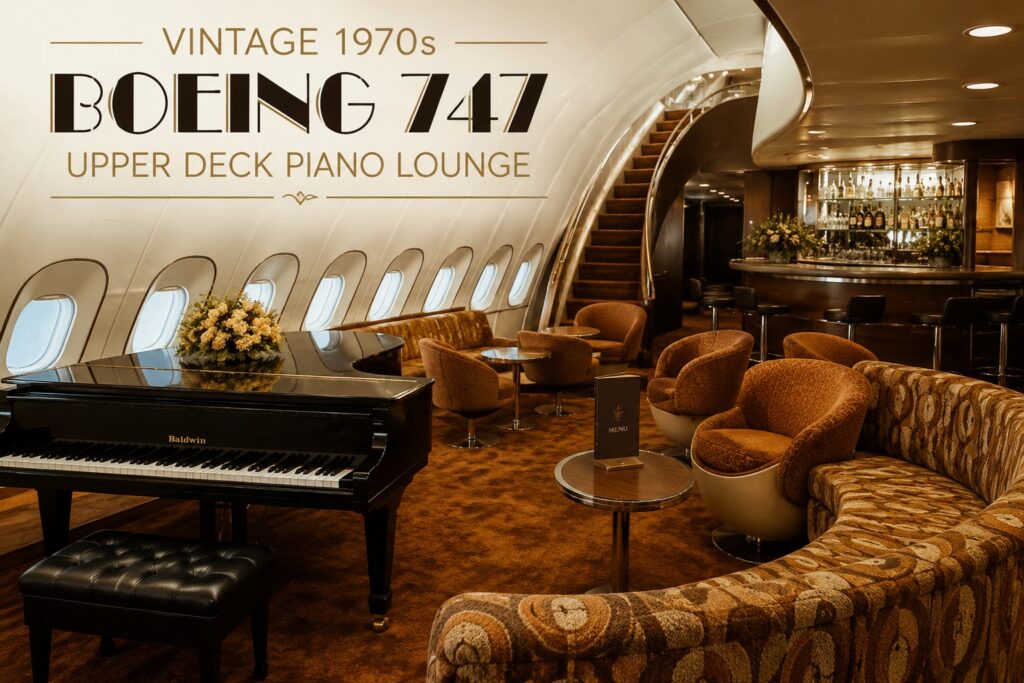
Picture this: you board a flight, climb a spiral staircase, and instead of finding another row of seats, you find a fully stocked bar with a live musician playing show tunes 30,000 feet above the ground. It sounds like a fever dream, but piano bars on airplanes were a real (and beloved) part of commercial air travel in the 1970s.
Long before in-flight entertainment meant a seatback screen, airlines were competing to give passengers the most unforgettable flying experience possible — and that meant cocktails, live music, and yes, an actual piano bar in the sky.
What Were Piano Bars on Airplanes, Exactly?
When Boeing rolled out the 747 in 1970, the plane’s now-iconic “hump” wasn’t just for looks. The cockpit sat above the main deck, which left an unused pocket of space right behind it. Airlines transformed that leftover space into full-blown lounges, complete with piano corners, candlelit dining areas, and plush club chairs.
Some carriers kept their piano bars upstairs for first-class flyers only. Others put democracy first: American Airlines placed its piano bar at the back of the main deck, behind the coach seats, so any passenger could grab a drink and enjoy live music.
American Airlines’ Legendary 747 Piano Bar
Of all the airlines that experimented with in-flight lounges, American Airlines’ piano bar is the one people still talk about decades later. Anyone could sit down and play, so a flight’s entertainment depended entirely on whether a talented passenger — or a musically gifted flight attendant — happened to be on board that day.
American marketed its 747s as luxury liners in the sky, and the piano bar was the centerpiece of that pitch. Passengers in economy could leave their seats, mingle with strangers, and sing along to whatever the “pianist of the day” happened to know.
Wait — Was It Really a Piano?
Here’s the twist most people don’t expect: those weren’t traditional acoustic pianos at all.
Tuning a piano mid-flight is nearly impossible, and turbulence or a rough landing could easily throw a traditional piano out of tune in an instant. To solve the problem, American Airlines opted for electric Wurlitzer organs instead, which held their pitch no matter how bumpy the ride got.
So technically, the “piano bar” in the sky was an organ bar. But nobody was arguing semantics while singing along at 500 miles per hour.
Other Airlines Got in on the Act
American wasn’t alone in turning its cabin into a nightclub. Several major carriers built their own signature lounges during this era:
- Qantas created the nautical-themed Captain Cook First Class Lounge, complete with a stand-up bar and rope detailing meant to evoke a sailing ship.
- Continental Airlines installed “Polynesian Pubs” in economy class on its DC-10s and 747s, and later added full pubs to its widebody fleet.
- Japan Airlines offered the “Tea House in the Sky” for a quieter, more contemplative take on the in-flight lounge concept.
- Boeing even pitched a jungle-themed “Tiger Lounge” concept, though it never made it onto a commercial flight.
Each airline used its lounge to stand out in an era when flying was still considered glamorous — and passengers dressed, drank, and socialized accordingly.
Why Piano Bars Disappeared From Airplanes
If in-flight piano bars sound incredible, you’re probably wondering why you’ve never boarded one. The short answer: economics.
As fuel costs rose and airlines shifted toward maximizing paying seats per flight, that “wasted” lounge space became far too valuable to give away for free drinks and organ music. Upper decks were eventually filled with first- and business-class seating instead, and by the 1980s, most airline lounges in the sky had been phased out entirely.
Today, a handful of airlines offer small onboard bars on certain long-haul routes, but nothing resembles the full-scale piano lounges of the 1970s. The closest most of us get is a replica: a recreation of Qantas’ Captain Cook Lounge is preserved today at the Qantas Founders Museum in Longreach, Australia.
The Legacy of the Airplane Piano Bar
There’s something fitting about the fact that even in an era obsessed with speed and efficiency, airlines once believed a live piano — or organ — was essential to a great experience. It says a lot about how much people value live music, even in the most unlikely of settings.
That instinct hasn’t gone anywhere. Whether it’s a lounge at 30,000 feet or a living room, a piano still has a way of turning a space into a gathering place. If the story of the airplane piano bar has you dreaming about bringing live music into your own home, DFW Piano Gallery can help you find the right piano to start the tradition on solid ground.
Sources:
Executive Traveller — Recalling the fabulous bars and lounges of the Boeing 747
VinePair — The Glamorous Airline Lounges In The Sky From The 1970s

