
The acoustic piano vs keyboard
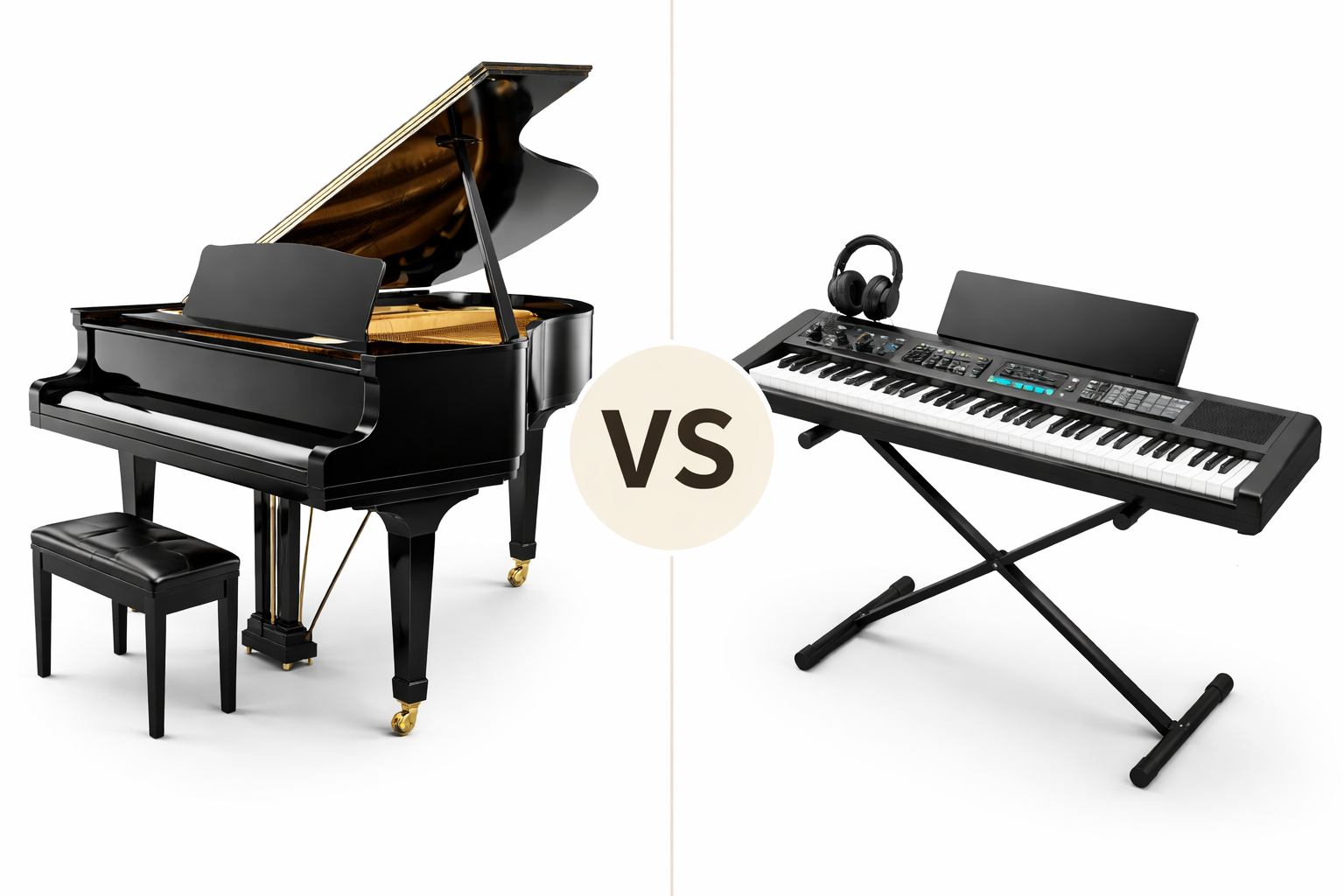
If you’re just starting out on piano, one of the first questions you’ll ask is: do I really need an acoustic piano, or can I just learn on a keyboard? It’s a fair question — keyboards are cheaper, lighter, and easier to fit into an apartment. However, if you’re serious about learning piano the right way, the honest answer is that an acoustic piano is the only real option. Here’s why.
Acoustic piano vs keyboard: why they’re not the same instrument
This is the most important thing to understand before you spend a single dollar. An acoustic piano and a keyboard are fundamentally different instruments. They look similar, and they play the same notes — but the experience of playing them, and what they teach your hands and ears, is completely different.
An acoustic piano produces sound through a mechanical action: when you press a key, a felt hammer strikes a steel string. The tone, volume, and character of every note you play is directly controlled by how you touch the key — the speed, the weight, the angle of your finger. That connection between touch and sound is everything in piano playing.
A keyboard, no matter how expensive, produces sound digitally. The keys trigger a sample or a synthesized tone. Even keyboards with weighted keys are simulating the feel of a real piano action — and simulation, no matter how good, is not the same thing as the real thing.
Why beginners need weighted, graded keys — and why keyboards fall short
One of the first things piano teachers will tell you is that proper technique depends on proper resistance. The keys of an acoustic piano are heavier in the low register and lighter in the high register — this is called graded hammer action, and it exists because of the physics of how an acoustic piano works. The bass strings are longer and heavier; they require more force to play expressively.
When you learn on a real piano, your hands develop strength, control, and sensitivity that is calibrated to this resistance. When you move to a performance or exam setting — which almost always involves an acoustic piano — your technique translates perfectly.
When you learn on a keyboard, even one marketed as having weighted keys, the action is a simulation. It may feel close, but it is not graded and weighted the same way. Students who learn on keyboards often struggle when they sit down at a real piano for the first time. Their touch is wrong. Their dynamics are off. Their hands simply haven’t been trained for the real instrument.
The role of touch and dynamics in piano learning
One of the most important skills a piano student develops is dynamic control — the ability to play softly, loudly, and everywhere in between, and to do so with nuance and intention. This is called touch sensitivity, and it is one of the defining qualities of a skilled pianist.
On an acoustic piano, dynamic control is entirely in your hands. Pressing a key gently produces a soft, delicate tone. Pressing it firmly produces a bold, resonant one. The full range of expression is available to you from day one, and developing that sensitivity is part of what you are learning every time you practice.
Most consumer keyboards have velocity-sensitive keys, which means they respond to how hard you press. But the feedback loop between your fingers and the sound is not the same as an acoustic piano. The subtlety just isn’t there. Students who learn on keyboards often develop a heavy, undifferentiated touch — they pound rather than play, because the keyboard doesn’t teach their hands to listen.
What about digital pianos?
There is an important distinction to make here between a keyboard and a digital piano. High-end digital pianos — instruments from brands like Yamaha, Kawai, and Steinway — have come a long way in recreating the feel and sound of an acoustic piano. Some models use real wooden keys with genuine hammer action, and the sound sampling is extraordinarily detailed.
If an acoustic piano is truly not an option due to space, budget, or noise restrictions, a high-quality digital piano is a much better choice than a keyboard. But even the best digital piano is still a compromise. It is designed to feel like an acoustic piano — which means the acoustic piano is still the gold standard it is being measured against.
Our recommendation is always to start on an acoustic piano if at all possible. A well-maintained used upright piano will teach your hands more than a brand new mid-range digital piano. The real thing is always better than the best imitation of it.
What piano teachers say
Ask any classically trained piano teacher what instrument they recommend for their students, and the answer is almost universally the same: an acoustic piano. This is not just tradition or preference. It is based on decades of observing how students develop — and how students who learn on keyboards hit a ceiling that students who learn on acoustic pianos do not.
The physical demands of playing an acoustic piano — the weight, the resistance, the responsiveness to touch — build the muscular memory and sensitivity that define real pianistic technique. You cannot shortcut that development on a keyboard. You can learn the notes. You can learn the songs. But you cannot develop the full skill of a pianist without the full resistance and responsiveness of a real piano.
The long-term cost argument of an acoustic piano vs keyboard
Many people choose a keyboard over an acoustic piano because it is cheaper upfront. This is completely understandable. But it is worth thinking about the long-term picture.
If your child or you take lessons for a year on a keyboard, progress will feel slower and more frustrating. When the time comes to perform, sit an exam, or simply play on a real piano somewhere else, the gap in technique will be immediately apparent. Many students end up purchasing an acoustic piano after the fact — which means spending money twice.
A quality used upright acoustic piano in the Dallas–Fort Worth area can be surprisingly affordable. When you factor in what you’re getting: a real instrument that will develop real technique, hold its value, and last for decades with proper maintenance, it is almost always the smarter long-term investment.
What about space and noise?
These are real concerns, and we hear them often. If you live in an apartment or have close neighbors, a full-size upright piano may feel impractical. There are a few options worth considering.
Many acoustic pianos can be fitted with a silent system — a mechanism that mutes the strings and routes the sound through headphones. This gives you the full acoustic action and key feel while keeping the volume to nearly nothing. It is a genuinely excellent solution for apartment living that does not sacrifice the quality of the instrument.
Smaller upright pianos, sometimes called studio or console uprights, also take up less space than you might think. If you visit our showroom in Dallas, we can walk you through options that fit a range of room sizes and living situations.
Our honest recommendation
We sell keyboards, digital pianos, and high-end acoustic uprights and grands. So when we tell you that acoustic is the way to go, it is not because we only carry one type of instrument. It is because after years of helping students and families find the right piano, we have seen consistently that students who learn on acoustic pianos develop faster, go further, and enjoy the process more.
If you are serious about learning piano — for yourself, for your child, or for anyone in your household — invest in the real thing. Your hands, your ears, and your future self will thank you. There’s really no question when it’s an acoustic piano vs keyboard.
Stop by our showroom in Dallas and let us help you find the right acoustic piano for your budget, your space, and your goals. We would love to be part of your musical journey.

